


The Spatial Multiomics Laboratory focuses on cutting-edge transcriptomic technologies, with spatial transcriptomics as the flagship area of its activity, as well as on single-cell RNA sequencing (scRNA-seq)–based gene expression profiling. We offer a comprehensive approach to molecular research, combining high-resolution gene expression data with precise mapping of their spatial localization within tissue architecture.
Since 2021, the Spatial Multiomics Laboratory has been a certified spatial transcriptomics service provider accredited by 10x Genomics, confirming the highest quality of delivered analyses and compliance with international standards. The certification is renewed annually and systematically expanded to include newly released spatial transcriptomics platforms, in line with the evolving 10x Genomics technology portfolio.
Our team has over four years of hands-on experience in spatial transcriptomics technologies, gained through the implementation of research projects and specialized international training programs. These trainings were conducted, among others, at the Department of Genomics, Berlin Institute for Medical Systems Biology (MDC-BIMSB), part of the Max Delbrück Center (MDC), as well as at the Laboratory of Genomics and Bioinformatics, Institute of Molecular Genetics, Academy of Sciences of the Czech Republic. This background provides a strong scientific foundation for the implementation of advanced basic and translational research projects.
We have extensive experience working with a broad range of biological materials, including brain, heart, skin, liver, kidney, lung, intestinal, pancreatic and adrenal tissues, as well as embryonic and developmental tissues. We carry out numerous projects in oncology, including analyses of solid tumors such as ovarian, breast, colorectal, lung and pancreatic cancers, as well as gliomas, in both primary tumors and metastatic lesions.
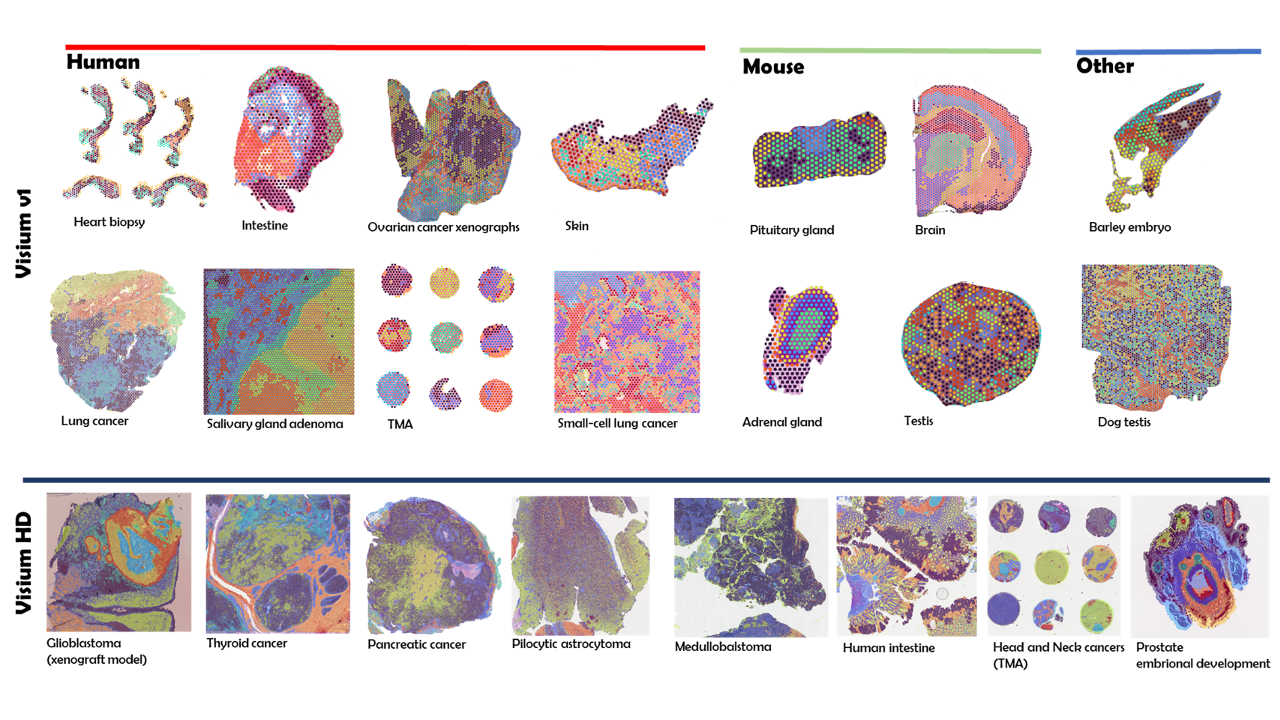 We work with clinical biopsies, post-surgical specimens and preclinical models, including tumor xenografts and animal models. Our analyses also cover immune system tissues (spleen, lymph nodes, tonsils and bone marrow) as well as tissues with complex microarchitecture, such as glandular, epithelial and connective tissues. We deliver projects at various scales — from single biopsies to tissue microarrays (TMA) enabling high-throughput comparative analyses.
We provide a comprehensive end-to-end analytical pipeline, covering all stages of the project — from optimization of histological preparation of FFPE and fresh-frozen (FF) samples, through data generation using 10x Genomics platforms (Visium CytAssist, Visium HD, Chromium), to advanced bioinformatics analysis. We employ state-of-the-art tools dedicated to transcriptomic data, including Loupe Browser (10x Genomics) and the Seurat framework with Harmony-based data integration, enabling consistent integration of multiple samples, experimental conditions and modalities. We deliver integrated spatial analyses and visualizations, including functional annotation of molecular biomarkers, signaling pathways and biological processes. The results we provide are publication-ready, suitable for interactive exploration and further downstream analyses, supporting our partners at every stage of the project — from experimental design to biological interpretation.
To date, our expertise has been trusted by numerous academic and medical institutions in Poland and abroad, including the Poznań University of Medical Sciences, University of Silesia in Katowice, Institute of Bioorganic Chemistry of the Polish Academy of Sciences, Mossakowski Medical Research Institute of the Polish Academy of Sciences, Wroclaw Medical University, Medical University of Bialystok, Poznań University of Life Sciences, Medical University of Gdansk, Łukasiewicz Research Network – PORT Polish Center for Technology Development, Lazarski University, Medical University of Lodz, as well as BioAvots SIA (Latvia) and Sidra Medicine (Qatar).
In parallel, we are actively involved as consortium partners in new research projects funded by the National Science Centre (NCN, Poland), in collaboration with Gdańsk University of Technology, the National Institute of Oncology in Warsaw, and Weill Cornell Medicine (USA), developing innovative multiomics applications for basic and translational research.
By combining high-quality histological workflows with advanced bioinformatics, we deliver precise, biologically interpretable results that support basic and translational research as well as the development of new therapeutic strategies. We are a trusted partner for academic teams, research institutes, and biotechnology and pharmaceutical companies.
Collaboration
We are open to both scientific and commercial collaboration.
Please feel free to contact us to discuss your project scope, technological possibilities, and tailored collaboration options.
📧 spatial@igcz.poznan.pl
📞 +48 61 65 79 209
🏢 Institute of Human Genetics, Polish Academy of Sciences
ul. Strzeszyńska 32, 60-479 Poznań, Poland